
A Different Planet
Two children eat ice creams on the cover of Martin Parr’s The Last Resort. Any other photographer would have wiped their faces first. Parr wanted the drips. Parr is the antidote to propaganda, which is not the same as kindness.
Parr died in December 2025, a satirist and a national treasure. Somewhere in Blackpool in the 1980s, we might have crossed paths.
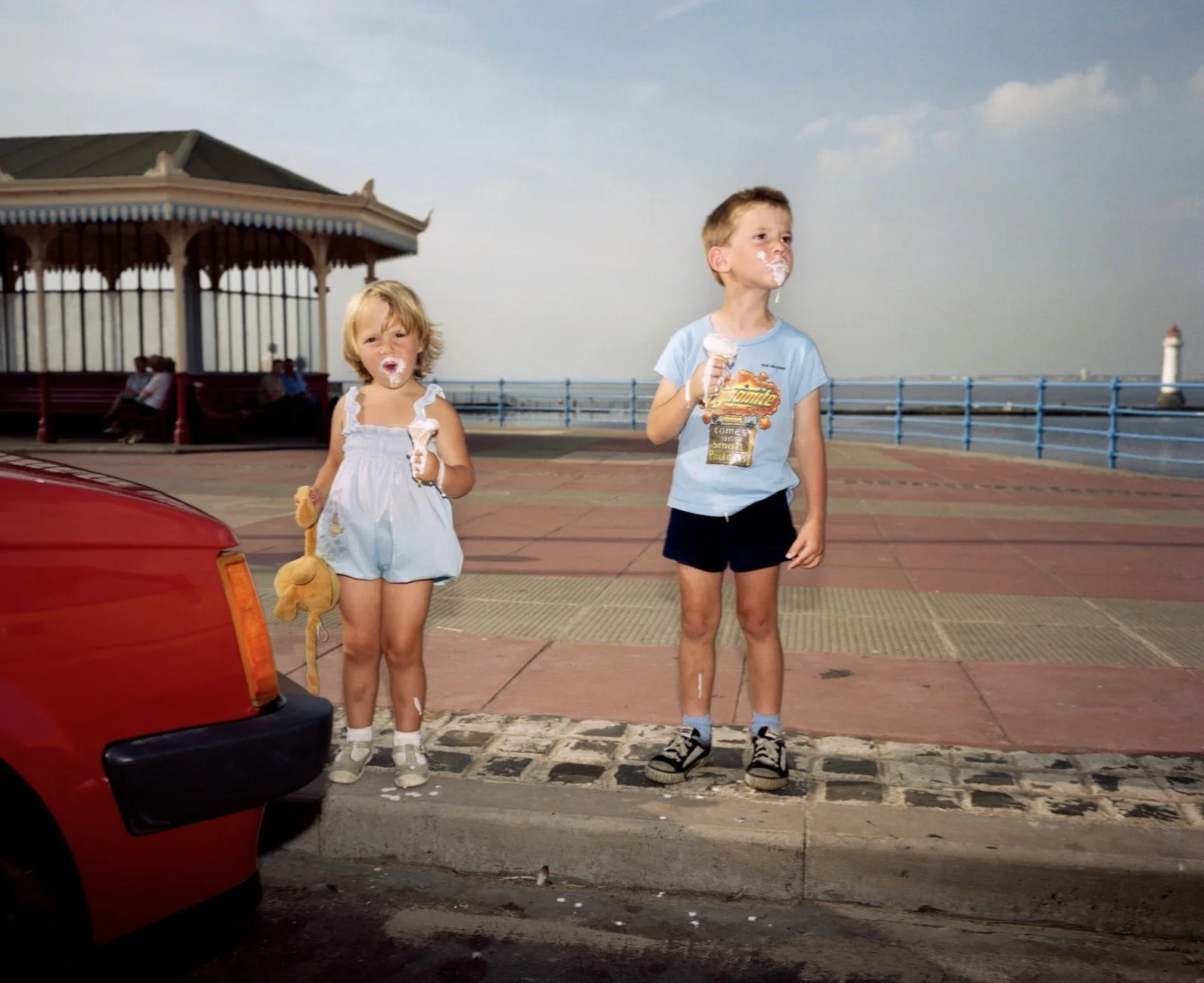
From Martin Parr’s The Last Resort (1986)
As a child, I visited Blackpool, a seaside resort about an hour north of Liverpool. I don’t remember why—probably a day trip to the beach. I recall crowded pavements, penny arcades, postcards (some quite rude), a pier, and Blackpool rock. Not the music or the geology type, but a long stick of boiled sugar, pink on the outside, white on the inside, with black letters spelling “BLACKPOOL ROCK” running its entire length, wrapped in crinkly clear plastic. I didn’t like it much (too minty), but no matter. I bought quite a few sticks for my lucky friends.
Blackpool in the 1980s had the same vibe as New Brighton, the seaside town Martin Parr photographed in The Last Resort (1986). It shows the working class on holiday, eating fish and chips, trying for a suntan (too cold and overcast), toes dipped in dirty water, discarded newspapers blowing in the wind. The cover photo of two children eating ice-cream cones is untidy. Most photographers—and most mothers, too—would have wiped the children’s faces and arranged the pose before taking this shot. Not Parr. He wanted the drips.
A Liverpool showing of these photographs was well received, but a show at the Serpentine in London was contentious. The objections came quickly. Parr—from Surrey and middle class—had photographed the Northern working class, and in color! In those days, color was for advertising and fashion, not social documentary. Tradition demanded that documentary be in black and white, ideal for portraying the tragic dignity of the down-and-out. Worse, Parr’s photographs did not flatter. I doubt anyone wants to be memorialized quite the way Parr captures them; most people wish to be remembered with their best foot forward. And that relentless flash, attached to his camera, lighting everything with the same indifference. Flash combined with saturated film (like Agfa Ultra) made the colors garish. Added to this exaggeration, Parr’s subjects had no power, no names, and no right of reply. How rude!
I am not as offended as those Londoners. When I look at The Last Resort, I do see not an insult but rather joy. These are my people. I am from Sheffield. We liked going to the seaside. We didn’t feel tragic. It was a grand day out, and yes, it included fish and chips. What else do you eat by the sea? Maybe it all looks slightly ridiculous, but this is the seaside. Isn’t that the point?
“All photographs are propaganda,” Parr said. “I am the antidote to propaganda.”
An antidote stops the harmful effect of poison; it is not neutral.
The poison, according to Parr, is so ubiquitous that we hardly notice—food on packaging that does not look like what’s in the packet; travel brochures that remove the crowds; family albums that show everyone happy. Smiling, he says, is also a form of propaganda—and boring. The antidote is to photograph the eating, not the meal. The crowd, not the monument. The drips, not the wiped face.
Satire is his secret weapon. It turns out the working class is not his target after all. His target is photographing what they have been sold. He is catching them in the act of consuming, and his target widens with his subsequent books.
The Cost of Living (1989) depicts the rise of the middle class under Margaret Thatcher—at garden parties, art viewings, private schools—a world I did not know. What I remember of Margaret Thatcher’s Britain is not prosperity, but the miners’ strike, the poll tax, the Falklands War, and the privatization of British Gas (“Tell Sid”).
Small World (1996) is about mass tourism, showing tourists being herded from one landmark to the next—the Acropolis to the Pyramids to the Grand Canyon. If you read this book, notice all the cameras in hand. It reminds me of a joke: How many tourists does it take to hold up the Leaning Tower of Pisa? Ask Parr.
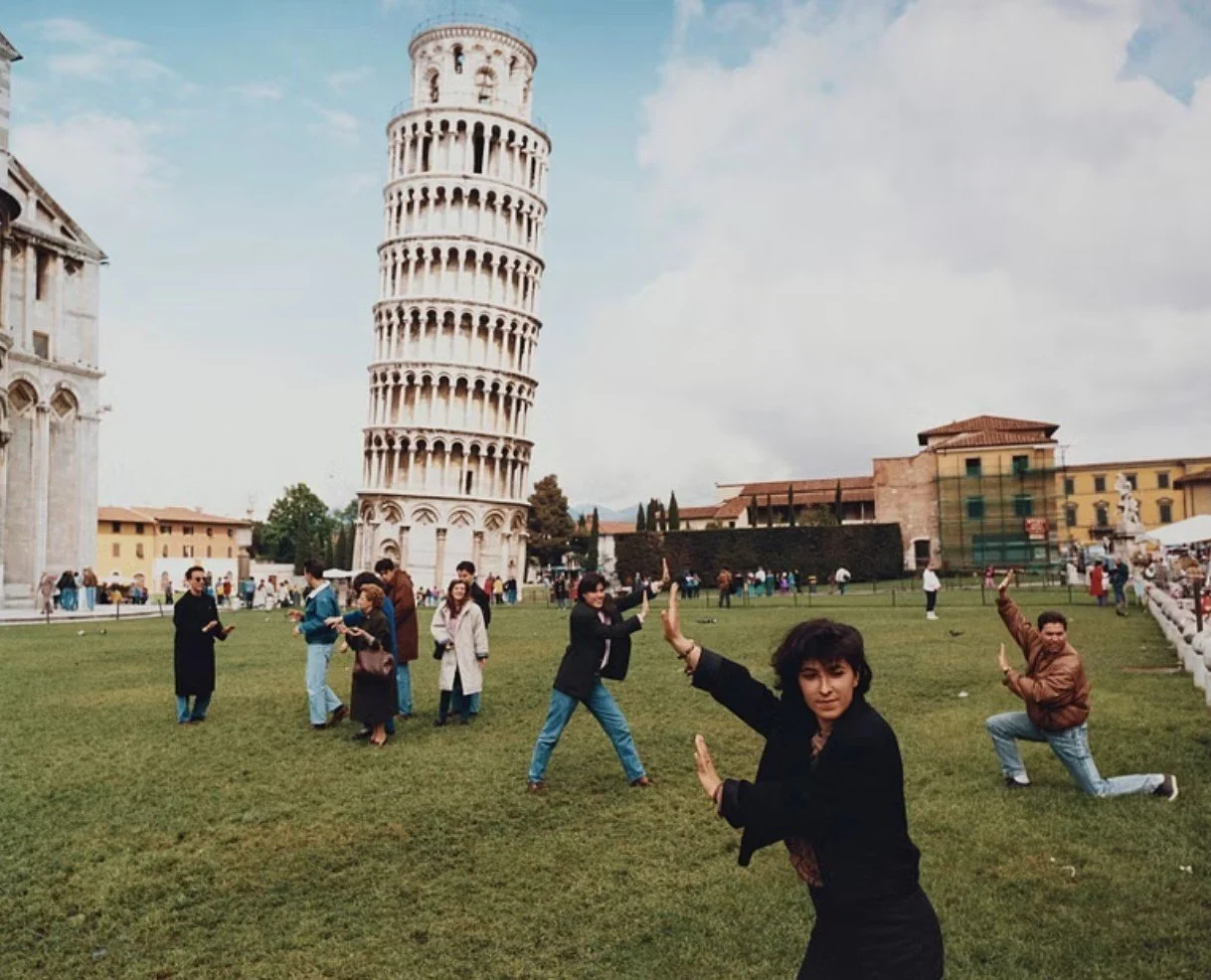
From Martin Parr’s Small World (1994)
Parr’s photographs exaggerate—a key element of satire. In Common Sense (1999), armed with a ring flash and macro lens, Parr worked close enough that ordinary objects became slightly strange. And the crop—a mouth, a fork, a torso—turned bodies into fragments of behavior.
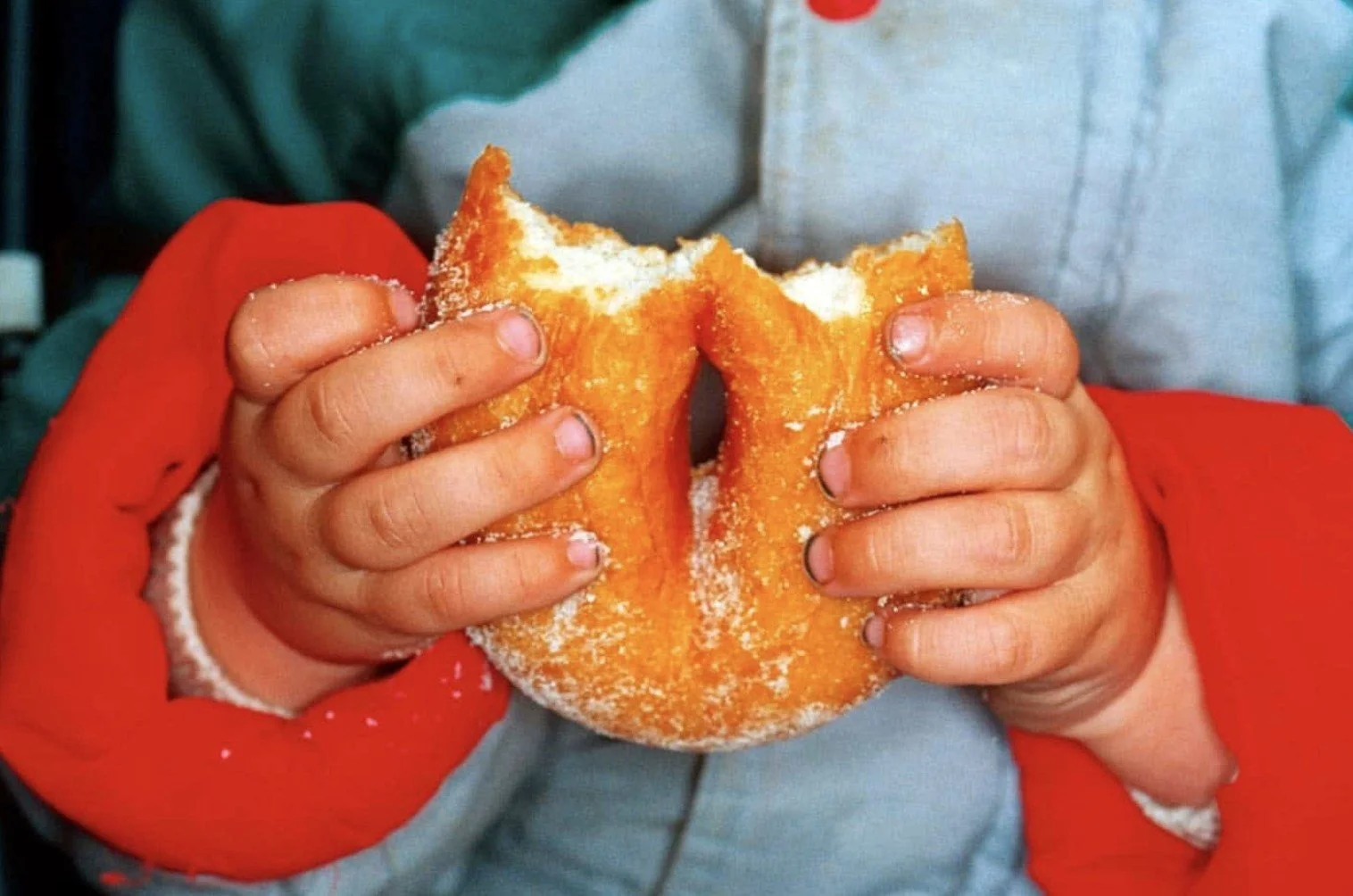
From Martin Parr’s book, Real Food (2016)
Luxury (2009) is about over-the-top consumption and the super-rich—at art fairs, race meetings, and parties in Moscow, Dubai, Miami. The visuals include diamond jewelry, pedigree pups, racing cars, and empty champagne bottles. “Luxury is the new poverty,” said Parr. “For years, the subject of social documentary photography has been poverty, whereas I think that the new front line is luxury.”
For me, the timing is the biggest deal. Parr’s photographs are not at all in the style of Henri Cartier-Bresson and his decisive moment. In the world of photography, Cartier-Bresson is a kind of god, and to reject his philosophy is sacrilege. In his 1952 book The Decisive Moment, he explains that pure visual harmony is achieved in that fraction of a second when all the elements in a photograph—the geometry, the composition, the humanity—perfectly align. Most photographers I know are obsessed with this idea.
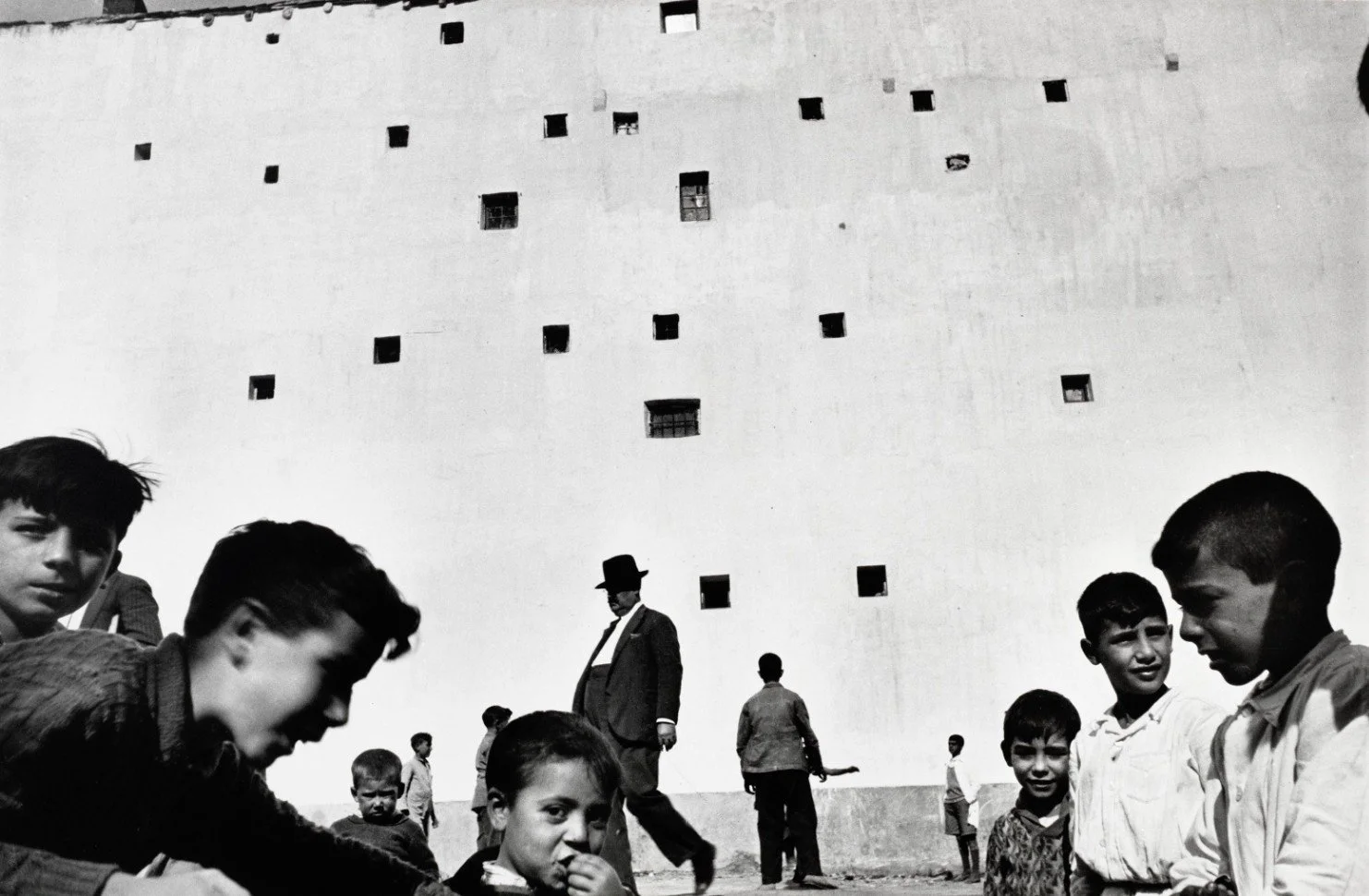
Henri Cartier-Bresson’s Madrid, 1933
Not Parr. He wanted the discarded moment—the instant just before or after that decisive one. I admit that learning this about Parr shook my worldview. I had always thought of the decisive moment as a rule, not an opinion. Why did this not occur to me before? As a rule-follower, I sometimes miss the obvious.
Who decides the rules? Rules are like culture—a set of morals, laws, customs, and beliefs of which we might not even be aware until we step outside them. I stepped away from my British culture when I moved to the United States. My first time in a grocery store by myself, I was overcome by the strangeness of it all and, unable to find tomato puree, had a little cry among the canned tomatoes. (Later, I learned that Americans call it tomato paste. How odd.) On my way home from the store, I observed but didn’t heed the blaring tornado sirens, since I didn’t know what they meant. I arrived home to find my anxious young husband alarmed that I had not jumped into the nearest bath. Culture shock is real. Is there such a thing as rule shock?
In 1947, Cartier-Bresson and friends founded Magnum Photos, a cooperative that ensured photographers owned and controlled their work. Parr joined the agency as an associate in 1988. Six years later, he was admitted to full membership, though not without opposition, including from Cartier-Bresson. Parr barely scraped in, admitted by a single vote over the required two-thirds majority. Two decades later, he was unanimously elected president.
Cartier-Bresson and Parr were at odds from the start. Cartier-Bresson used natural light and called flash “impolite”; Parr loved flash. Cartier-Bresson disliked color and worked in black and white; Parr loved color. Cartier-Bresson preferred to go unnoticed (he even painted the chrome on his camera black); Parr worked uncomfortably close—no one could miss him. Cartier-Bresson wanted the decisive moment; Parr wanted the discarded moment. Cartier-Bresson dignified his subjects; Parr, at best, suspended judgment. Differences aside, they both photographed people—or the things people make.
In the mid-1990s, Cartier-Bresson saw a Martin Parr exhibition in Paris and declared that Parr came from a different planet. Parr acknowledged the large gap between their work but replied, “Why shoot the messenger?” Their quarrel was short-lived; they reconciled over a lunch arranged by Cartier-Bresson’s wife, Martine Franck, also a Magnum photographer. In 2022–23, the Cartier-Bresson Foundation in Paris presented an exhibition, Cartier-Bresson with Martin Parr: Reconciliation, featuring fifty images by each photographer of northern England and its coast, including Blackpool.
A satirist and a national treasure. That’s the verdict on Parr, who died in December 2025. The two ought to be incompatible. In England, they seldom are: we do not silence our satirists; we collect them. The National Portrait Gallery holds Hogarth and Gillray, alongside the rakes and the kings they ridiculed. It holds a photograph of Monty Python, six men together in 1982, whose Life of Brian was picketed as blasphemy and banned up and down the country; one of them is now a knight. And it holds Parr—three portraits of him, seven by him, and a solo show in 2019. Absorption works better than censorship because it does not require the joke to be wrong. It requires only that we enjoy it, which we do.
If Parr and I had been at Blackpool Beach on the same day way back when, our paths might have crossed. If he had photographed me—a kid consuming minty pink rock—would I have understood? If my photograph had appeared in one of his books, would I have been alarmed, or honored? Could I have absorbed the satire enough not to be a little hurt?
I’m not sure.
Luxury (2009) is about the super-rich—in Ascot, Moscow, Dubai. “Luxury is the new poverty,” said Parr. “For years, the subject of documentary social photography has been poverty, whereas I think that the new front line is luxury.”
Parr’s photographs exaggerate—a key element of satire. Flash in daylight flattens skin, hardens the background, and lights everything with the same indifference. Color was already an exaggeration, but saturated film (Agfa Ultra) pushed it further. Later, in Common Sense (1999), armed with a ring flash and a macro lens, Parr worked close enough that ordinary objects became slightly strange.
Then there was the cropping—a mouth, a fork, a torso, a sausage—which turned objects into fragments of behavior. And the timing: not Cartier-Bresson’s decisive moment but the one either side of it, mid-blink, mid-adjustment. The discarded moment. Which was a complete revelation to me. The decisive moment—when all elements in a picture perfectly align—is the holy grail of photography. Why? I had never thought to question this “rule.”
Parr joined Magnum as an associate in 1988. Six years later, he became a full member, though not without controversy. Magnum is a cooperative for photographers, founded on humanist reportage by Cartier-Bresson and friends. Some said Parr did not fit. Philip Jones Griffiths opposed Parr, calling him “Margaret Thatcher’s favorite photographer” (she never said so) and the antithesis of everything Magnum stood for. Full membership required a two-thirds majority; Parr secured it by a single vote.
Later, around 1996 (Parr’s recollection), Cartier-Bresson wrote to Parr after seeing an exhibition of Parr’s work. Parr, he said, was “from a totally different planet.” Parr’s response? “Don’t shoot the messenger.”
Who decides the rules? Parr broke Cartier-Bresson’s rule and quite a few others. I’m more of a rule follower, though arbitrary rules are annoying. My instinct is to be polite, complimentary, and composed. Sometimes I’m not even aware of it, like this “decisive moment” thing. I’m probably missing a whole lot of other good stuff, waiting for perfection. But I don’t want a mid-blink Parr picture. It’s not what I’m looking for. If I take one picture of a subject, I usually take a hundred frames, so I have plenty of options. Almost always, one is better than all the rest. This is my moment.
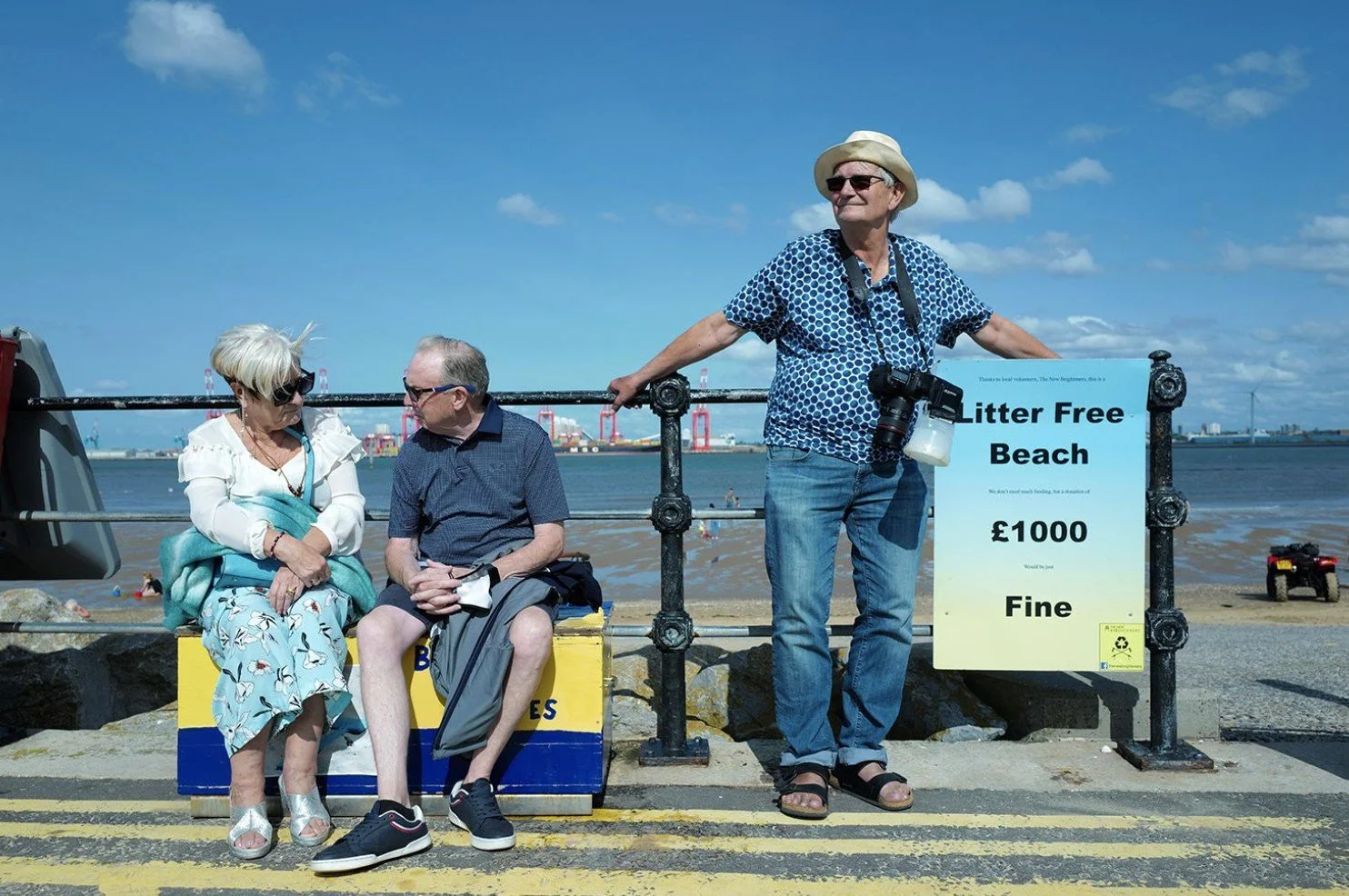
A still from the movie, I Am Martin Parr, released in 2025
A satirist and a national treasure. That’s the verdict on Parr, who died in December 2025. The two don’t necessarily align, except that this is what the English do: absorb the satire with good humor, then hang it in the National Portrait Gallery.
It turns out Parr went to Blackpool in his black-and-white days, before color. We might have crossed paths. If he had photographed me at the counter, handing over money for pink minty sugar I wouldn’t eat, for friends who didn’t want it either—could I have understood him? Forgiven him? Have I absorbed the satire enough not to be a little hurt?
I’m not sure.