
Strengthened by Words
Dorothea Lange spent her career insisting that words extend the medium of photography, but the lines she filed with “Migrant Mother” weren’t entirely accurate. The record was corrected in 1978 by the woman in the picture and again in 2002 by her son. I've been working out what all of this means for a book of my own and whether it should include any text.
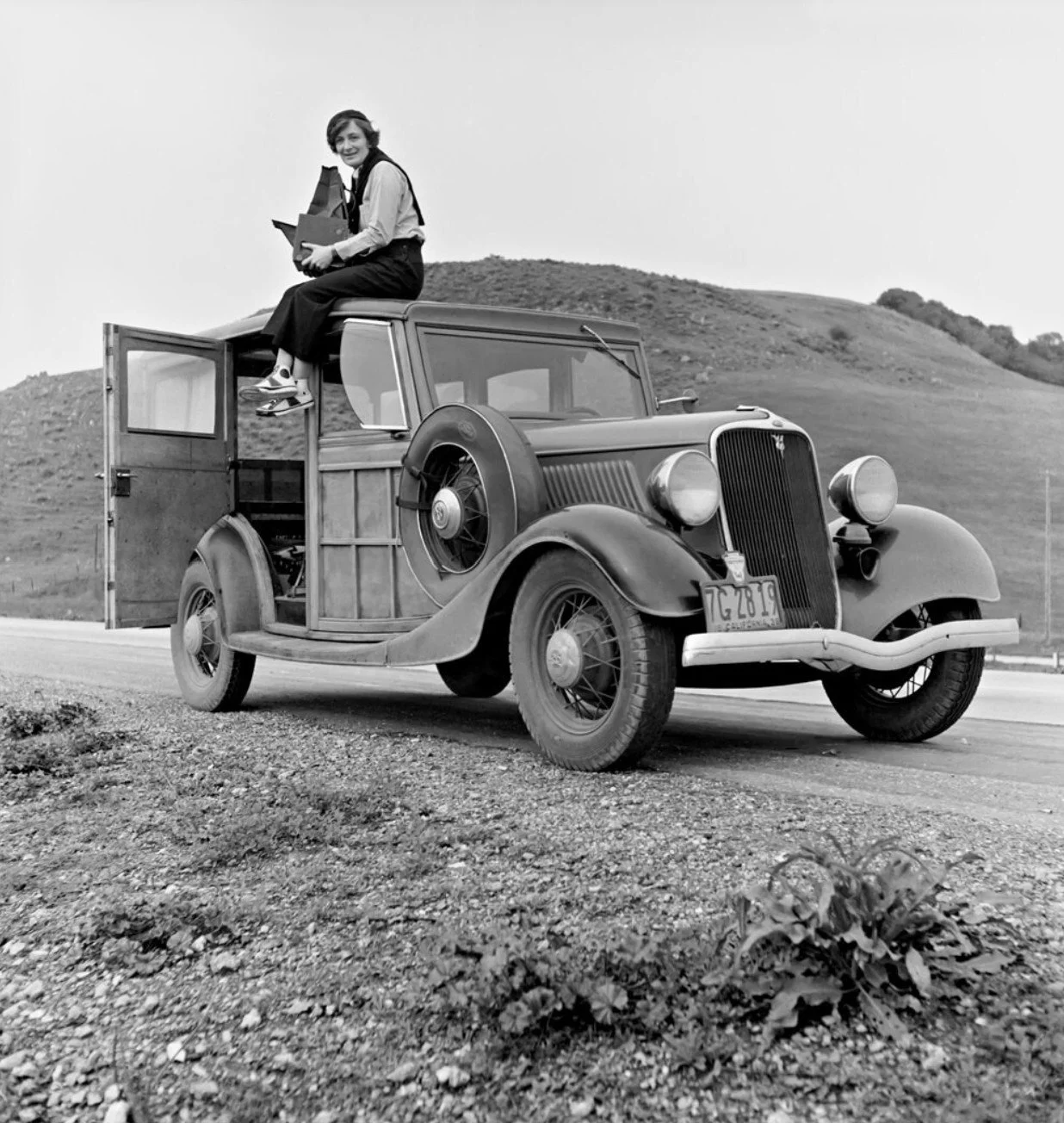
Dorothea Lange, Resettlement Administration photographer, sitting atop a Ford Model 40 in California. In her lap is a Graflex 4×5 Series D camera. Public domain.
Do photographs need words? More personally, should my book Cambridge include text?
Text and photographs combine in many ways: titles, captions, news copy, explanations of intent or method, poetry, interpretation, essays. Even words in the photograph itself. Most photographs carry some form of text; if not, Untitled seems to suffice. Words might equal the photographs, complement them, explain them, antagonize them, or do something else entirely.
Photographer Dorothea Lange (1895-1965) spent her career thinking about the relationship between photographs and words. In the last year of her life, she was writing captions for a retrospective at the Museum of Modern Art. Writing to John Szarkowski, the show’s curator, she said that captioning was not clerical work, but added factual information and clues to attitude, relationship, and meaning. “All photographs,” she wrote, “not only the so-called ‘documentary’ … can be strengthened by words.” Words, she said, “extend, buttress, illuminate, and explain.”
Lange’s most famous photograph, “Migrant Mother,” taken in 1936, only received this name in 1952, from Lange’s son, Daniel Dixon, in an article in Modern Photography. Before that, it had been titled “A destitute mother, the type aided by WPA,” “A worker in the peach bowl,” and “In a camp of migratory pea pickers, San Luis Obispo County, California.” Normally, Lange kept detailed field notes, but not this time: she was rushing home when she saw the encampment and backtracked. No name, no interview, just some quick work then back on the road.
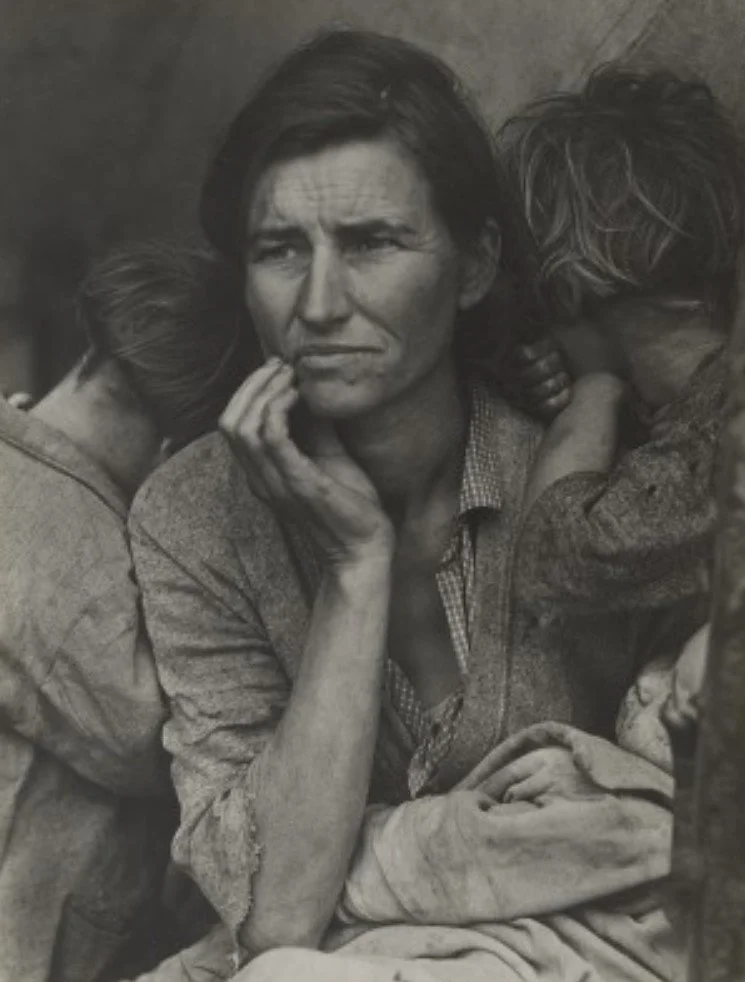
Migrant Mother, Nipomo, California, 1936. Dorothea Lange. Library of Congress, Prints & Photographs Division, FSA/OWI Collection, LC-USF34-9058-C. Public domain.
The 1936 note Lange filed with this picture for the FSA read, “Seven hungry children. Father is native Californian. Destitute in pea pickers’ camp … because of failure of the early pea crop. These people had just sold their tires to buy food.” Her Library of Congress note read, “Destitute pea pickers in California. Mother of seven children. Age thirty-two. Nipomo, California.” Later, in 1960, in an article for Popular Photography, Lange repeated the story of the tires being sold.
In 1978, a reporter for the Modesto Bee, Emmett Corrigan, acting on a tip, found the woman in the photograph. She was living in a mobile home in Modesto, California, and her name was Florence Owens Thompson. The paper published a letter she had written, and the Associated Press carried the story. She said she wished Lange had never taken the picture. It hung all over the world, she said, and she could not get a penny out of it. Lange, she continued, had not asked her name, had promised not to sell the pictures, and had promised to send a copy that never came.
In 2002, Thompson’s son, Troy Owens, told journalist Geoffrey Dunn in a San Luis Obispo New Times piece titled “Photographic License” that they had not sold the tires. Nor were they pea pickers. They were driving north from the Imperial Valley toward the lettuce fields at Watsonville when the car’s timing chain broke, so they pulled into the camp to repair it. While removing the chain, they put a hole in the radiator. He and his brother hauled the radiator into Nipomo on a hand wagon for repair — which is where they were the afternoon Lange arrived. Regarding Lange, Owens said, “I don’t believe Dorothea Lange was lying, I just think she had one story mixed up with another. Or she was borrowing to fill in what she didn’t have.”
So it is that Lange, who believed that all photographs were strengthened by words, gave her greatest photograph four lines: two of them untrue, and a third — that the father was a native Californian — accurate but misleading, since Jim Hill was father of only the younger children. A caption can be correct and, by what it chooses to say, give the reader only a part of the story. Words, it seems, do not always fortify, nor extend, buttress, illuminate, and explain.
In 1939, Lange and her second husband, Paul S. Taylor, published their book An American Exodus: A Record of Human Erosion. The book documents rural poverty and displacement during the Great Depression: her photographs paired with his text, which includes government notices, folk-song lyrics, newspaper headlines, and direct quotes from sharecroppers, displaced people, and migrants, who “vaguely regarded conversation with us as an opportunity to tell what they were up against to their government and to their countrymen at large. So far as possible we have let them speak to you face to face.” Their voices on the endpapers make a fascinating read.
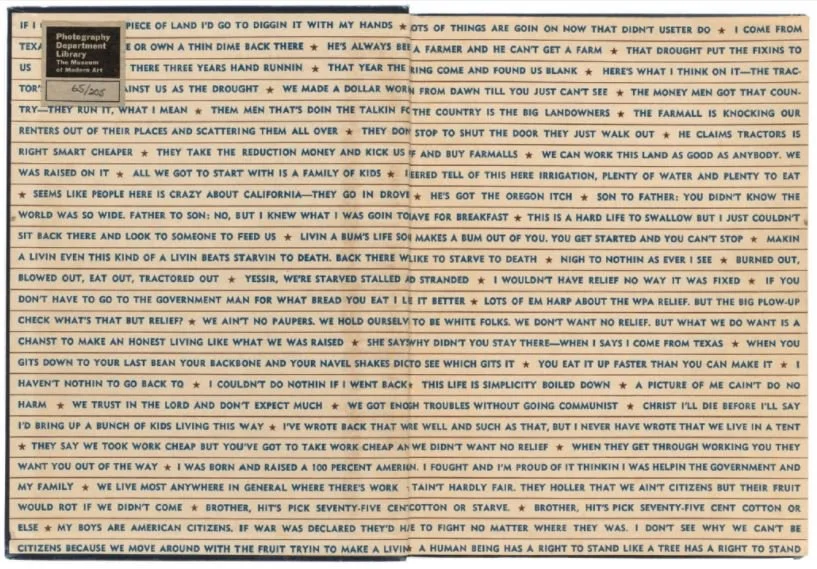
Endpapers, Lange and Taylor’s An American Exodus: A Record of Human Erosion, 1939.
In 2020, fifty-four years after Lange’s first exhibition, MoMA gave her a second: Dorothea Lange: Words & Pictures. The curator, Sarah Hermanson Meister, commissioned thirteen writers, artists, and critics to respond to individual Lange photographs with new words. Among those commissioned was Sally Mann, who has often expressed admiration for Lange’s work and discussed her influence on her own practice. Mann wrote a short, poetic response to Lange’s photograph “The Defendant, Alameda County Courthouse.”
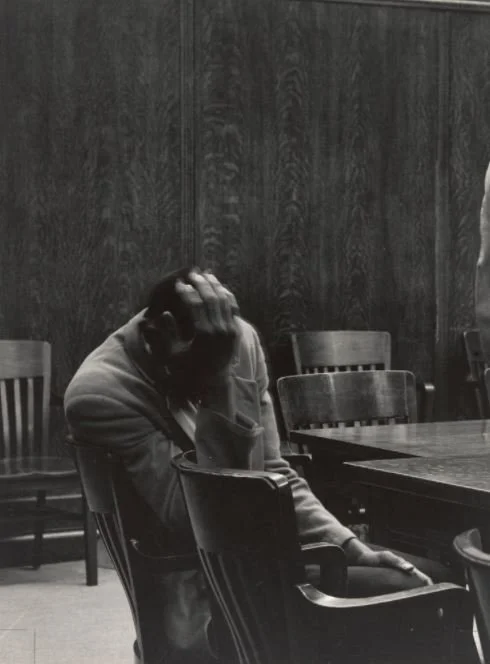
The Defendant, Alameda County Courthouse, California, 1955-57. Photograph by Dorothea Lange. Museum of Modern Art, New York.
In an interview related to the show, Mann calls the relationship between words and pictures a “complex amalgam.” Words might come before the photograph, as they did in her photobook Deep South (2005), which was partly inspired by William Faulkner’s The Sound and the Fury. When making her Deep South photographs, Mann said, an image that worked was like a tuning fork trembling inside her — the Faulknerian picture in her mind slotting into place. Or the works might come after, which is harder since photographs overwhelm the memory of the scene.
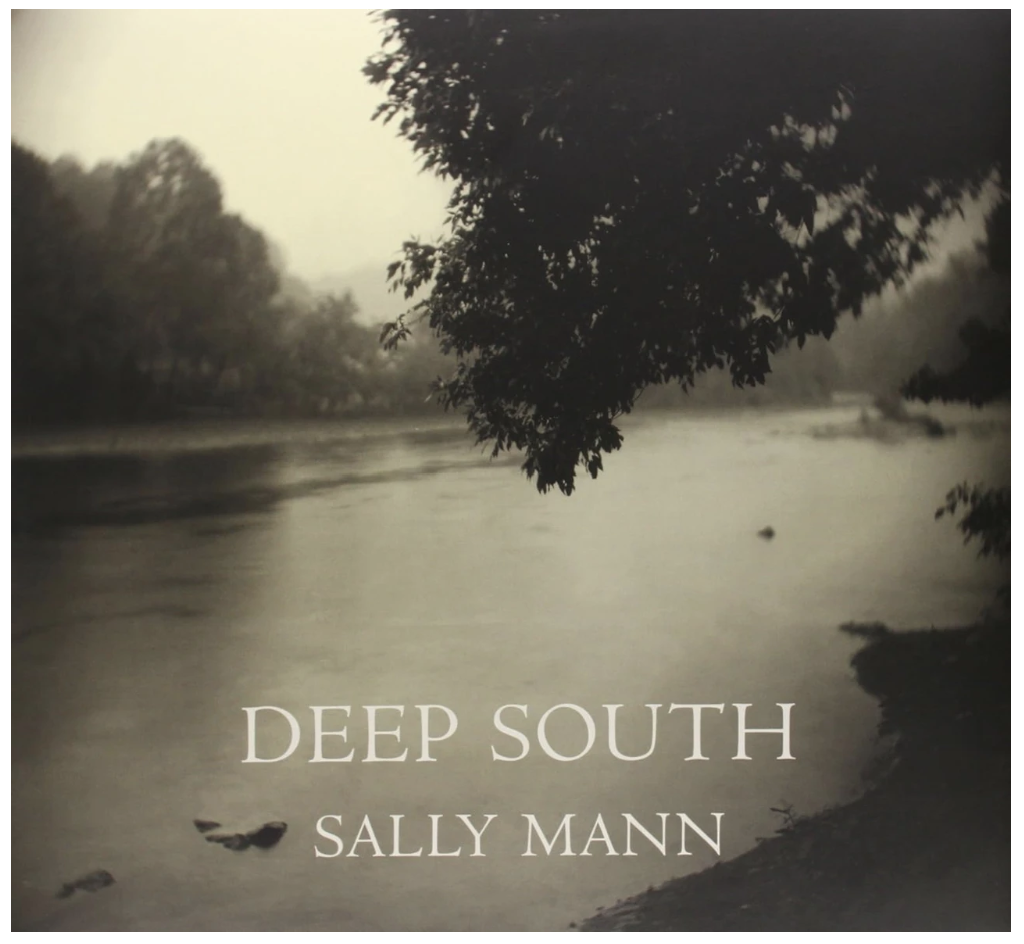
Cover, Sally Mann’s Deep South (2005)
This gives me four models so far: a caption that asserts fact (Lange’s “Destitute pea pickers…”); text that supplies argument and context (as in Lange and Taylor’s An American Exodus); the commissioned essay that interprets from the outside (Mann’s response to “The Defendant”); and when the words come first (Mann’s Deep South).
Do these models fit my Cambridge book? Any captions that assert fact will be limited to location and date; I didn’t keep detailed field notes. I don’t expect to use external text or speech excerpts. No outside commissioned essays. Nor did words come first. But I can write after. So what if memory overwhelms the scene?
Looking elsewhere, I found two more models. The first is Gwen Raverat’s Period Piece: A Cambridge Childhood, published in 1952 — a delightful account of growing up. Her real subject is not Cambridge, though it was her home, but what it was like to be her. The second piece I enjoyed is M. R. James’s short ghost story “A Night in King’s College Chapel,” written about 1892, in which figures in the stained-glass windows come to life. Memoir and invention. The interior and the imagined.
I like the Raverat direction: a memoir, though not about my university days. I’d like to weave in some Cambridge history, too, about kings and queens, churches, colleges, and the people. Raverat was safe because her subject was herself, but history is other people’s stories. Having just considered what happens when a photographer puts words to a stranger, I will have to be careful. If I explain a person — or a statue or a memorial, which speaks for the dead — can it ever be more than a guess?
And perhaps a touch of M. R. James — the hidden observer of his story, like me with my camera. Exactness and humor combined. His glazed figures speak, as do my photographs. Invention is safe when announced as such. Lest memoir and history turn too serious, James gives me to smile at Cambridge and love it too. Which I do.
Do my photographs need words? No. But I’ll add some anyway, to extend, buttress, illuminate, and explain. Short essays (like this one) about myself and Henry VIII, and myself and the Queen. Not all royalty, though; places too — like myself and Magdalene Street. And events: like myself and World War II. In the process, I learn about me, and about Cambridge. How well can anyone know a place? At best, maybe only as well as I can know myself, which is to say, not completely, but worth a try.